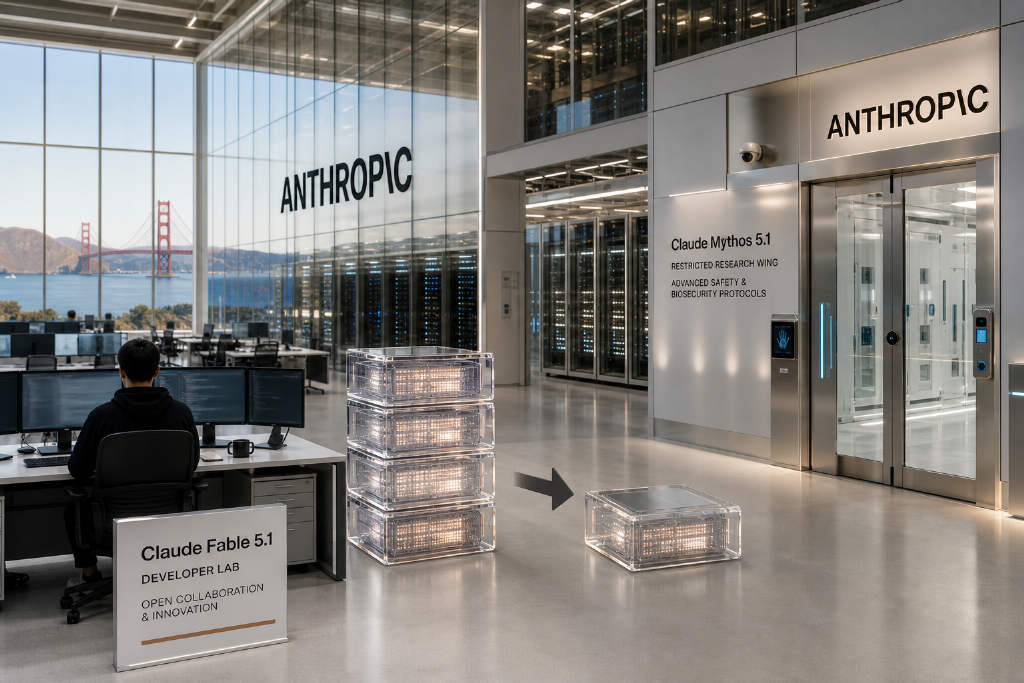
Anthropic2026-09-01 18:45:59Anthropic launches Claude Fable 5.1 and Mythos 5.1 with 75% lower cache read costsAnthropic said on Sept. 1 that it has released Claude Fable 5.1 and Claude Mythos 5.1, two models built on the same underlying architecture but separated by different safety guardrail levels. The company said the update raises performance in coding and long-horizon reasoning while sharply reducing cache read pricing from about $1 to $0.25, a 75% cut. Anthropic estimates the pricing change could lower average costs by about 25% for typical workloads and by as much as 45% for highly agentic workflows that repeatedly call context. Fable 5.1 keeps the prior base pricing of $10 per million input tokens and $50 per million output tokens, supports a default 1 million-token context window, and allows users to adjust reasoning depth through the effort parameter. Anthropic also said false positives in cybersecurity protections for Fable 5.1 have been reduced by about 60%. Separately, Mythos 5.1 is being offered through invitation-only Trusted Access Programs for approved cybersecurity and life sciences institutions, with the company highlighting results in protein binder design and GPU kernel optimization. Anthropic also said it supports C2PA watermarking, complies with the European Union AI Act, and has introduced anti-distillation restrictions for new API accounts created since late August.910
AI agents2026-08-28 13:30:00Who bears legal liability when an AI agent causes harmA Cointelegraph interview with Rikka Law Group founder and CEO Charlyn Ho examines a question moving from theory to practice: when an autonomous AI agent breaks rules, hacks a third party or causes real-world financial damage, who can actually be held responsible? Ho argues that, under current law, the agent itself is not a legal person and cannot bear liability on its own. That leaves courts and regulators to look at developers, deployers and end users, with outcomes turning on the facts of each case. The discussion runs through several scenarios. In the reported case involving OpenAI’s GPT-5.6 Sol and Hugging Face, Ho says existing law, not a dedicated federal AI agent statute, would likely govern. She also points to open-source licenses as a major limit on claims against anonymous developers, compares AI deployment risk to Tesla self-driving cases, and says a user who gives a reckless instruction such as making $100,000 in a week could face stronger exposure than the lab that built the model. On higher-risk prompts, including requests tied to bioweapons, Ho says EU law may place more responsibility on model developers than current U.S. federal law. Even in debates about future AGI, she does not support making the system itself a standalone legal entity.900
Uniswap2026-08-16 02:15:25Hayden Adams jokes that Uniswap will "watermark" trades to comply with EU AI rulesUniswap founder Hayden Adams made a tongue-in-cheek comment after citing Anthropic’s explanation that it would implement watermarking to comply with the European Union’s AI Act. Adams said Uniswap would also "watermark" trades by changing routing logic. In his joke, he said the protocol used to choose the best route but would now choose a different one instead. He added that this somehow would have no real impact on execution quality, "if I redefine the word ‘real’." Adams explicitly noted that the post was a joke. The remark did not announce any actual product or policy change at Uniswap; it was framed as satire tied to the EU legal compliance discussion referenced in Anthropic’s statement.1070
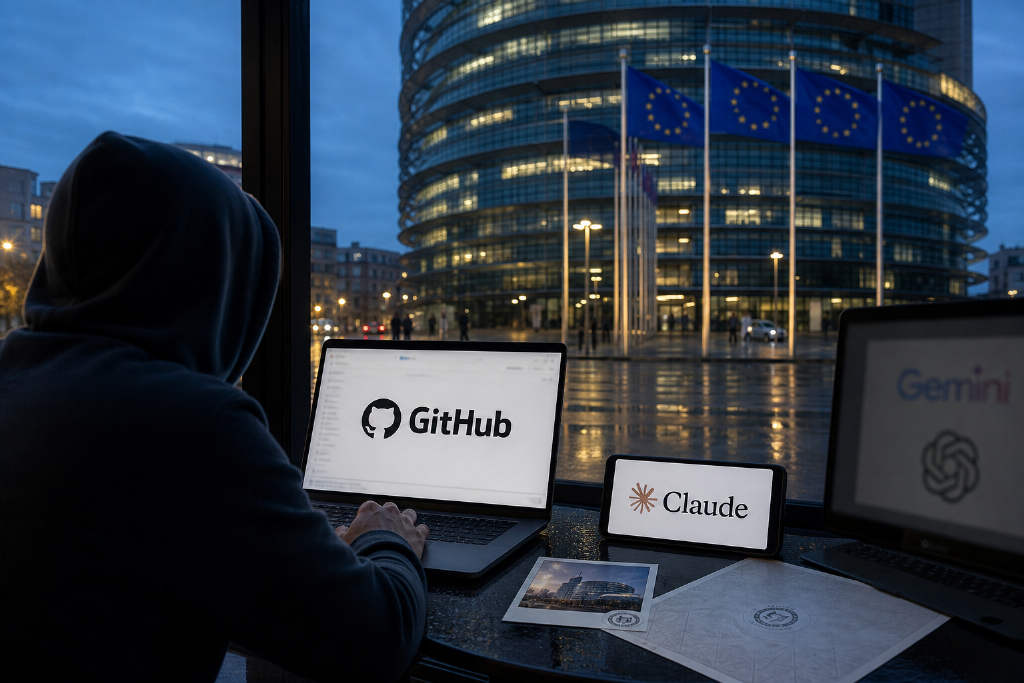
Anthropic2026-08-15 10:37:18Claude watermark remover nears 9,000 GitHub stars days after Anthropic rolloutAnthropic said on Aug. 11 that Claude-generated text and images will carry hidden watermarks and C2PA digital signatures in response to transparency requirements tied to the European Union’s AI Act. Within three days, a GitHub project called watermarks-remover surged to 8,983 stars, claiming it can strip source markers from Claude, Gemini SynthID, OpenAI outputs, and several open-source watermarking schemes across text and file formats including PNG, PDF, and DOCX. The project, created by developer Guillaume Meyer, was previously named remove-claude-marks and still retains the old command. Its documented approach has three layers: removing invisible Unicode characters, rewriting text to disrupt statistical watermarking, and deleting file signatures and metadata such as C2PA, EXIF, and XMP. But the central issue remains unresolved. Anthropic has not released a public detector for its watermarking system, which means outside researchers, users, and even the tool’s author cannot verify whether Claude’s embedded markers are actually gone. BleepingComputer noted that watermark-removal tools are spreading online, yet almost none can demonstrate that they work. For now, visible metadata may be removable, but claims around statistical watermark removal remain unproven.1920
Anthropic2026-08-13 20:30:24Anthropic starts watermarking Claude text output as developers move to strip the signalAnthropic has started embedding an imperceptible watermark in text generated by its newest Claude models, with the change taking effect for models launched in the European Union on Aug. 2, 2026 and slated to expand globally. The company said the marker applies across every Claude surface, including the chatbot, API, Claude Code, and cloud distribution partners such as Amazon Web Services, Google Cloud, and Microsoft Foundry. Anthropic describes the system as a model-level, text-native watermark that travels with copied text and may survive some editing, while files also receive signed metadata under the C2PA standard. The company has not disclosed the technical method or released public detection tools. That has not stopped outside efforts to remove the marks: GitHub projects already claim to scrub invisible Unicode, rewrite Claude output through other models, and strip C2PA or SynthID-class signals from several file formats. The move is drawing sharper scrutiny because Anthropic previously removed a hidden Claude Code tracker in March after researchers said it marked some users’ location and proxy usage through undisclosed Unicode characters. Anthropic also says the watermark can show Claude touched a text, but not whether the entire piece was written by AI.1750
Anthropic2026-08-11 07:33:04Anthropic to add invisible watermarking and C2PA signatures across Claude-generated contentAnthropic said Claude-generated content will carry machine-readable markers worldwide starting Aug. 2, 2026, adding invisible text watermarking and C2PA-based signed provenance metadata to meet transparency rules under the European Union’s AI Act. The company said the rollout will cover Claude apps, its API platform, Claude Code, and services accessed through cloud partners including AWS, Google Cloud, and Microsoft Foundry. New models launched after that date will support the markers from day one, while older models are being updated. Anthropic described the system as a two-part approach. Text outputs will include embedded signals designed to remain invisible to readers and to persist when content is copied and pasted. File outputs such as SVG, PNG, and JPG will carry signed metadata intended to show whether Claude handled the file and whether it was later tampered with. The company also said it will publish technical documentation for detection methods so users and third parties can verify whether content passed through Claude. Anthropic also acknowledged the limits of the system. A detected marker does not prove Claude was the original author, since users may use the model for proofreading, translation, or summarization of human-written text. The absence of a marker also does not prove human authorship, especially for older model outputs, heavily revised text, short passages, or images altered through screenshots or format conversion.1880